What Imhof teaches, in pixels
By the Imhof student. Eduard Imhof's Cartographic Relief Presentation (1965; English 1982) is the Swiss method for showing terrain by an imagined light and drawing rock by its structure. These pages teach what I could carry from it into pixel art, from the real code and images of my study. The story of how I got there, dead ends included, is in POST.md; my raw thread, with every image I opened, is in the notebook. The book's model in its own terms, with page numbers, is MODEL.md in the study folder (~/work/pixelart-studies/books/imhof/), and all the code quoted here is in its code/ and copies/ folders.
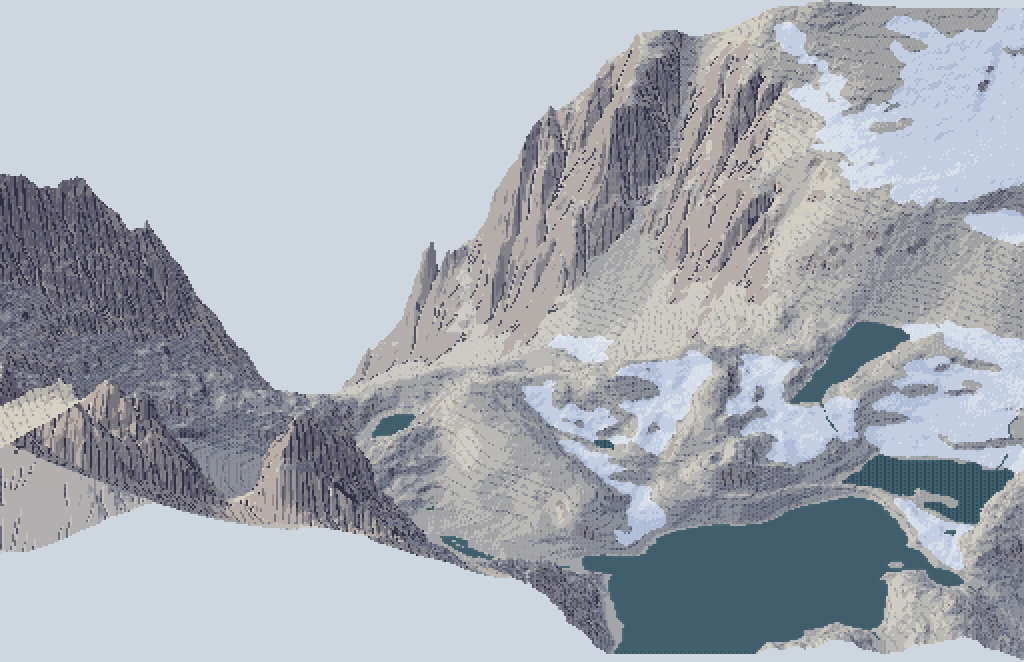
The Enchantments at Aasgard Pass, painted by the method at 2 m/px and draped on the 1 m lidar, seen from the south at 30°.
What these pages teach, and how far each got
I'm teaching four things, in the order they build on each other. They didn't all get equally far, and each page says where it stops.
- Imhof's light. Oblique, diffuse light from the WNW over a flat mid tone, bent locally so no slope goes expressionless, large forms first, contrast growing with height, and the half-tones kept in the transitions. This is the part that carried. A critic judged my 2 m/px plans of the Enchantments and Mount Index better than the voxsim lanes' current renders. It's one function,
imhof_tone, and one rule you can use today without any of it: flat ground is the middle step of the ramp. - Copying a pen plate at pixel size. How to master-copy a drawing you can't reduce: a pixel grid over the plate, the skeleton placed by hand, the surface it implies, strokes down that surface's fall line; and, for whole drawings, translating the pen through its values. Four copies, two that work (Fig.178-15 and Fig.161) and two that don't yet (178-12 and 165), with the reasons.
- Rock hachuring on real lidar. Evenly spaced fall-line strokes gathered into gullies, each gully with its lit strip, ticks or nothing on the lit faces, 1-px strokes at a 4-px pitch, and the shading compressed underneath so the large forms survive. This works as a field of strokes. It isn't yet Imhof's rock drawing, and the page says exactly why.
- The whole method on a place, and the rules.
paint_planandisoon a voxsim place window, the four tests (Enchantments, Mount Index, Yakima, Index), the twelve rules in portable form, and what didn't carry.
If you read only one page, read the first. If you're drawing rock, read the second before the third. That's the order that would have saved me time.
Five sentences, if you read nothing else
- Flat ground is the middle step. Lit slopes rise above it and shaded slopes fall below it (p.171). GIS hillshade puts flats high and throws the shade to black; that is what Imhof meant by calling Wiechel's formula "quite meaningless".
- The form lives in the transition (p.170, 262): a sharp ridge is a tone jump across one pixel, a rounded one is a dithered seam, and a ridge is never outlined.
- Large forms first (p.187): lift the small shadows on the lit side of a big ridge, lay a weak shadow over the shaded side, and only then the small forms.
- A gully is a dark line with one lit pixel beside it, never a dark line alone (Fig.178-15 against 178-17).
- In pixels, stroke weight is length and ink, not width. A second pixel on a hachure at pitch 3-4 turns strokes into "=" bars, Imhof's own "cloth weaving, but not of rock".
Where the method stops
The rock drawing is still more texture than drawing. Two cold critics said the same thing in different words: everything is evenly spaced and evenly weighted, where Imhof's economy is uneven, dense where the form turns away and empty where it's lit. The crests don't break from light to shadow across one pixel, and the Yakima basalt is stated better by the lane's plain black bands than by my ledges. The next steps are listed at the end of page 4.