6. The palette is the light
← pockets, not outlines · front page · next: material marks →
When: always. Paint steps (front page), then choose a ramp per rock, hour and wetness at render time.

One index canvas rendered through five palettes. Same stones, same steps, same pixels; only ramp(rock, hour) changes. Made by code/figs.py.
Note the limit: the index map fixes the direction of the light (it decided which pixels are lit). The palette changes the light's colour and key. To move the sun, repaint (sheet D, page 10). This is the same as Ferrari's colour-cycling scenes, where morning and afternoon share one index map.
One ramp: nine steps, a hue walk in Lab (palette.ramp)
Each ramp is built in CIE Lab, from four ingredients:
- Lightness per step from the rock's albedo. Granite's lit face is L* 72 and basalt's is L* 46. The shadow family sits below the rock's shadow value, and a gap is kept at the terminator (EDGE is always at least 5 L* above SH_LIGHT).
- The light's hue: the sun's hue on the lit family (steps 4–8), the sky's on the shadow family (0–3), and a 60/40 mix of sky and sun on the reflected step (3), because the bounce comes off the sunlit gravel.
- The rock's own tint under both, strongest in the halftones (steps 4–6), where the light is least coloured.
- A chroma envelope that peaks in the halftones and falls toward black and toward the top light. Ferrari's rock ramps are saturated in the middle and grey at the ends.
ROCK = {'granite':   dict(L_fl=72, L_sh=30, tint=(45, 4)),      # pink-grey
        'greywacke': dict(L_fl=62, L_sh=25, tint=(165, 4)),     # green-grey
        'basalt':    dict(L_fl=46, L_sh=16, tint=(260, 5)),     # blue-black
        'gravel':    dict(L_fl=60, L_sh=25, tint=(120, 4))}     # the matrix: the rocks' average

HOUR = {'noon':     dict(sun=(80, 6), sky=(265, 9), gap=1.0, top=1.0),
        'morning':  dict(sun=(70, 12), sky=(255, 12), gap=1.05, top=1.0),
        'golden':   dict(sun=(60, 26), sky=(290, 14), gap=1.2, top=1.05),
        'dusk':     dict(sun=(20, 18), sky=(305, 16), gap=0.8, top=0.85),
        'overcast': dict(sun=(230, 3), sky=(235, 6), gap=0.55, top=0.9)}

def ramp(rock='granite', hour='noon', wet=0.0):
    r, h = ROCK[rock], HOUR[hour]
    Lfl, Lsh = r['L_fl'], r['L_sh']
    g = h['gap']
    Lsh_scale = Lsh * (1.0 if g >= 1 else 1 + (1 - g) * 0.9)     # overcast: shadows lift
    Ls = [Lsh_scale * 0.35, Lsh_scale * 0.62, Lsh_scale * 0.85, Lsh_scale * 1.08]
    span = Lfl - Ls[-1]
    Ll = [Ls[-1] + span * f for f in (0.28, 0.55, 0.78, 1.0)] + [min(97, Lfl + 12 * h['top'])]
    Ls[-1] = min(Ls[-1], Ll[0] - 5)                                # keep the terminator gap
    Lv = np.array(Ls + Ll)
    if wet > 0:
        Lv[:8] = Lv[:8] * (1 - 0.3 * wet)                          # wet: darker ...
    env = np.array([0.25, 0.45, 0.7, 0.9, 0.85, 1.0, 0.9, 0.7, 0.35]) * (1 + 0.25 * wet)   # ... a bit richer
    ab = []
    for i in range(9):
        own = hue(*r['tint']) * (1.2 if i in (4, 5, 6) else 0.8)
        light = hue(*h['sun']) if i >= 4 else hue(*h['sky'])
        if i == 3:
            light = 0.6 * hue(*h['sky']) + 0.4 * hue(*h['sun'])    # reflected: bounce off lit gravel
        ab.append((own + light) * env[i])
    rgb = lab_to_rgb(np.concatenate([Lv[:, None], np.array(ab)], 1))
    if wet > 0:
        rgb[8] = lab_to_rgb(np.array([min(98, Lfl + 24), *(hue(*h['sun']) * 0.4)]))   # the glint
    return [tuple(int(c) for c in x) for x in rgb]
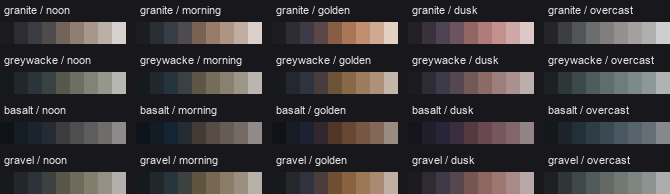
The ramps: four materials (rows) under five hours (columns), steps 0–8 from left to right.
Why these particular choices
- Albedo first. At pixel scale a stone's material reads first from its value family. Basalt is basalt because its whole ramp sits two steps lower (page 7).
- Small tints. Chroma 4–5 for the rock's own tint is less than it looks. The hour's light does most of the colouring, and that's why one rock reads as the same rock at every hour.
- The gravel ramp. It's its own "rock", the average of the others. My first ground ramp was a warm tan borrowed from sand, and the far bar turned into a different material (page 4).
- Overcast. It closes the gap (
gap=0.55) and lifts the shadows. Without a sun, the lit/shadow split nearly vanishes, and so does the cast shadow (stage3.pyskips it).
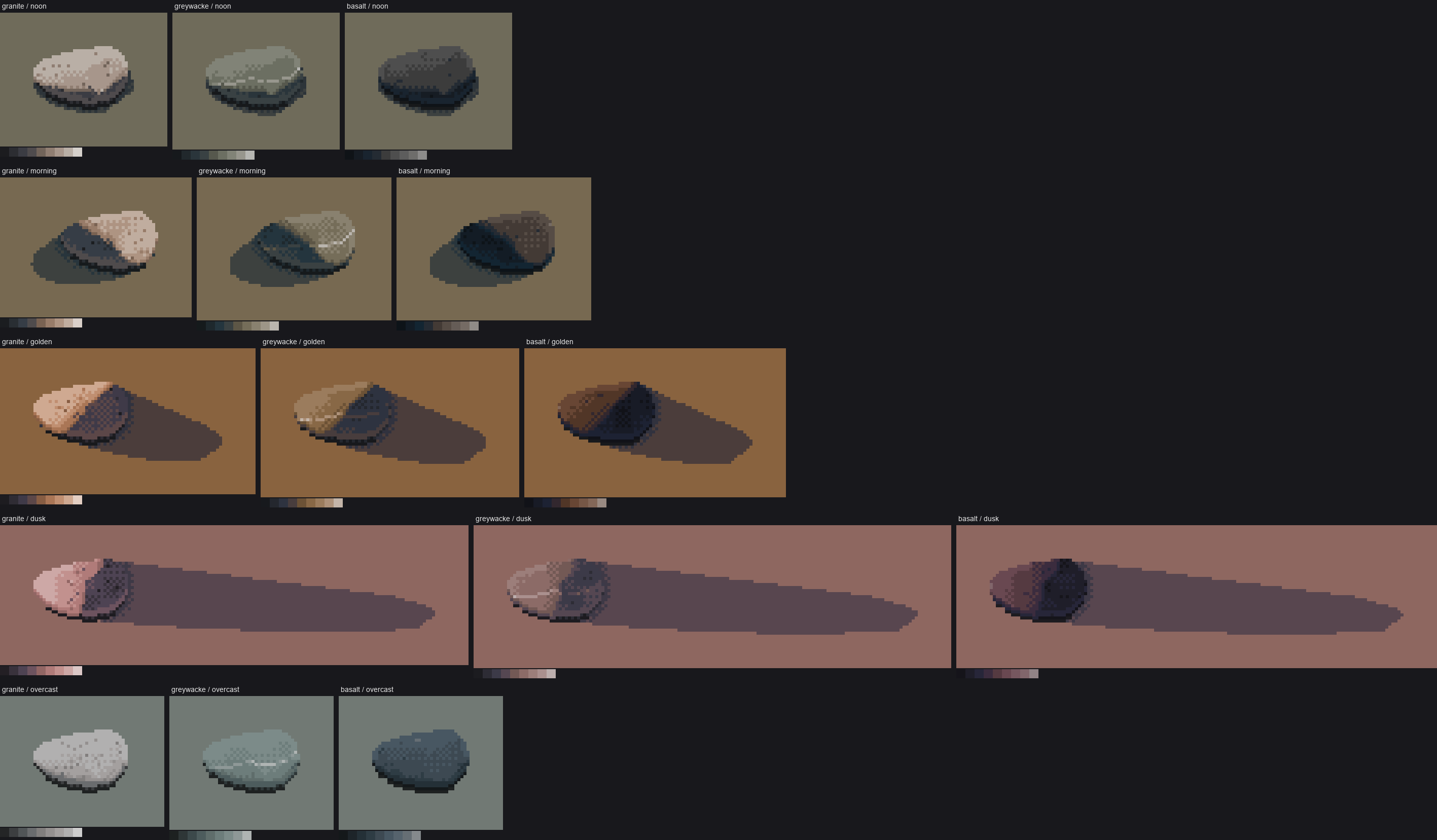
Stage 3: a single cobble of each rock under each hour.
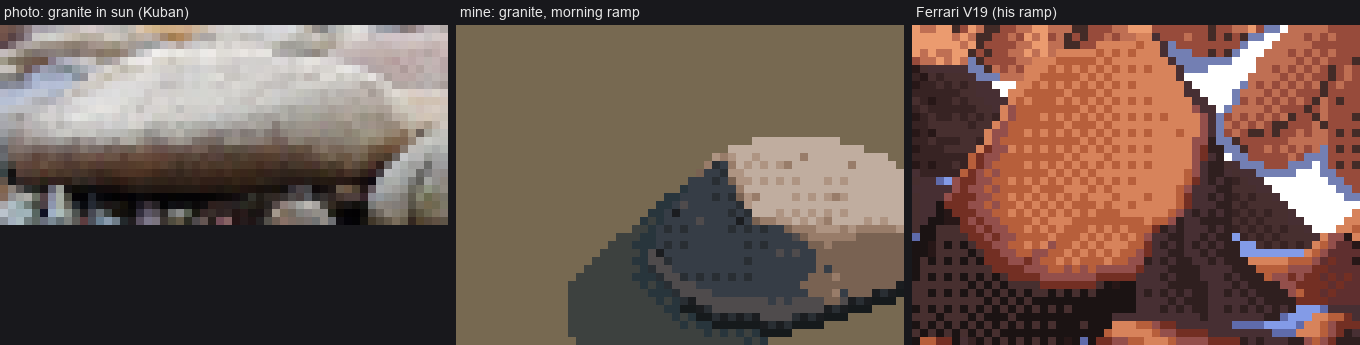
A granite cobble in sun (Kuban) | my granite on the morning ramp | Ferrari's V19 ramp.
Traps
- Golden and dusk suns throw long cast shadows, and flat polygons of the shadow step become graphic shapes, not painted ones. The ramp is right, but the shadow drawing (page 5) needs more work at low sun.
- Wet glint. The wet TOP step is near white. Anything that lands on TOP by accident (a vein, a light fleck) becomes a glint. In sheet B, wet greywacke veins sparkle; it's defensible (wet quartz), but busy.